A stage with two audiences - the ECP Green Summit for Expresso
On 7 October we ran the livestream of the ECP Green Summit for Expresso at the Portugal Pavilion in Lisbon, in a room with the stage in the middle and an audience on each side. The shape of the room decided everything else, from the six cameras to the second mix for the screen.
At around nine in the morning on Wednesday 7 October, we went live from the Portugal Pavilion in Lisbon on Expresso's Facebook page. We came off air close to six in the evening, with breaks along the way. Over the day, thirty speakers took the stage at the ECP Green Summit, the event that closed the Ecoceramics and Crystal of Portugal agenda: set up under Portugal's Recovery and Resilience Plan, it ran forty projects to decarbonise the ceramics and crystal industry. Expresso, the Portuguese weekly, was media partner and brought us in for the livestream.
The brief fit in one sentence: cover the event. What it would take to cover it was decided a month earlier, on a visit to the room.
The September visit
On 11 September, Rafael Reigota went to the Pavilion to see the auditorium. We knew straight away that our usual setup would not work. The stage sits in the middle, with an audience on each side, facing each other.
 The room from the balcony, on the September visit: the stage in the middle and an audience on each side.
At a typical conference, the stage has one front. The cameras sit on the audience side, the speakers talk to them and to the room at the same time, and the director cuts between shots that all face the same way. The Pavilion had two fronts, and whoever was on stage would turn to one audience, then to the other. With every camera on one side, each time a speaker turned to the other front, the stream would show their back.
Rafael also brought back the set and lighting design. The screen and the shape of the stage limited where the cameras could go, and we built the plan around those limits.
That room needed more cameras and one more operator than a conference with a single front.
Six cameras, three on each side
We rigged six PTZ cameras, three for each audience. On each side, two went at the top of the seating and the third down by the stage. The cameras reached the control room over NDI, into vMix, and our feed to the room's screen went out the same way. Graphics came to us over SDI.
 One of the two audiences, seen from the stage in September. Two cameras went at the top of each.
The room has little natural light, and lighting was in the hands of another AV team. We made the decisions that affected the cameras together with them.
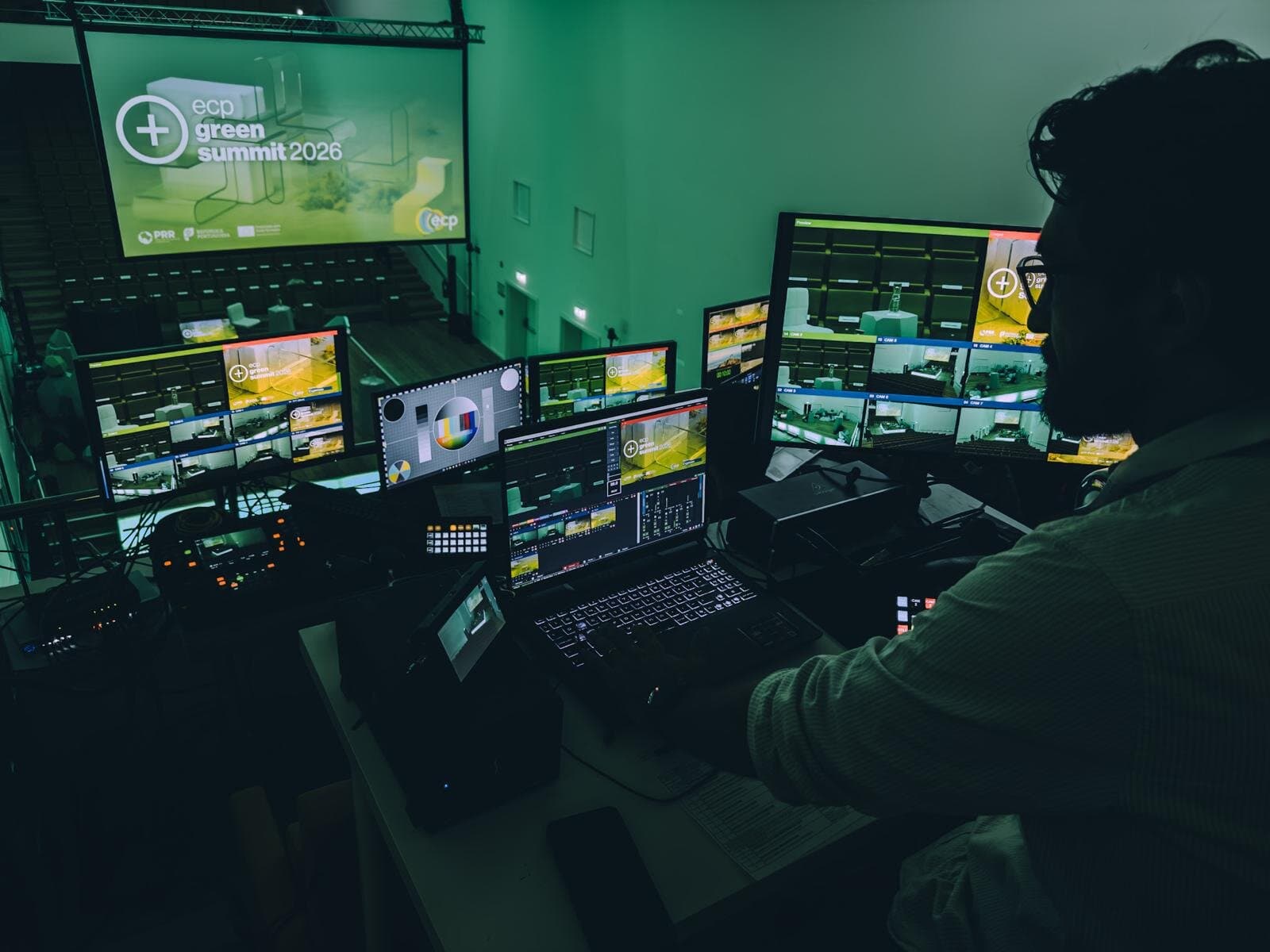
We arrived in the morning, and the rig took the whole day. On air, each operator took one side: I had one audience, the other operator had the other, each of us with our own multiview. We talked to Rafael, who was directing, over intercom. The opening photo is the control room that day, with the six cameras on his screen.
A second mix for the screen
Everything was well lined up. The hardest technical problem was the room's screen. It took shots from our cameras, but some of those cameras had the screen itself in frame. If one of those shots went to the screen, the room would see the picture inside the picture, repeating like a tunnel: video feedback.
So we built a second mix, for the screen only, which never took a shot with the screen in it. The Facebook stream had its own direction, and the room's screen had its own, with its own rules.
 The room on the day, with both audiences seated, the energy debate on stage and a shot from our cameras on the screen. Photo by José Fonseca Fernandes, Expresso.
Crossing the line
The directing problem was a different one. With cameras on both sides of the stage, cutting from one side to the other crossed the line: someone looking left was suddenly looking right, and the viewer lost track of who was talking to whom. Watching closely to avoid it, Rafael went through a wide shot between two cuts, so the jump would not show.
In the debates, the speakers stood side-on to both audiences. It was not ideal for the people in the room, but it worked for the stream, because we relied mostly on the cameras by the stage, which faced the speakers head-on.
 The conversation on skills and training. Photo by José Fonseca Fernandes, Expresso.
The people who felt the room most were the speakers themselves. With an audience on each side, anyone giving a presentation walked from one front to the other, splitting themselves between the two.
The video report
Alongside the livestream, we produced the video report that Expresso published with its article on the event, in Portuguese. A freelance camera operator we hired shot it, a journalist we also hired wrote the script, and Rafael handled post-production. The full day's stream is still on Expresso's Facebook page.
What we took from it
Expresso asked us to cover the event. In this room, that meant more cameras, one more operator and a separate mix for the screen. The September visit showed us that in time to plan for it. With our usual setup, we would have found out about the two audiences live on air.